Saint Patrick School in Pelham
2015 NH Has Closed
Saint Patrick School was a private Roman Catholic elementary and middle school in Pelham, New Hampshire. It was established in 1960.
The Saint Patrick School closed in August 2015 due to lack of enrollment for the upcoming school year.
This was the school's website.
Content is from the site's 2014-2015 archived pages.
Saint Patrick Catholic School
16 Main Street
Pelham, NH 03076
~~~~~
Welcome to Saint Patrick Catholic School
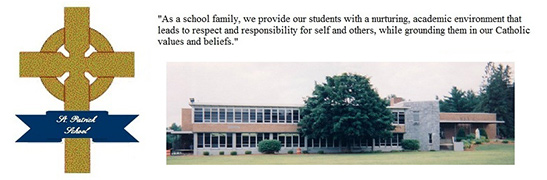
As a school family, we provide our students with a nurturing, academic environment that leads to respect and responsibility for self and others, while grounding them in our Catholic values and beliefs.
About Our School
Saint Patrick Catholic School is a private Roman Catholic elementary and middle school located in Pelham, New Hampshire. The school serves students in pre-Kindergarten through 8th grade. Founded in 1960 by Saint Patrick Parish, it was originally called St. Patrick Convent School and was staffed by Sisters of Mercy from nearby Windham, NH for many years. More lay teachers were gradually employed, and in the early 1990s the school’s name was officially changed to Saint Patrick School. Today, the school is staffed entirely by state-certified lay personnel. Saint Patrick Catholic School is accredited by the New England Association of Schools and Colleges.
It was so sad when Saint Patrick Catholic School had to close. My close friend's daughter and son had attended the school. I remember when she learned of the school closing. We were at a contemporary Italian furniture showroom in Philidelphia. She had driven down to Philadelphia to attend a wedding and was staying with me. She decided to spend a couple of extra days after the wedding so I could show her some of the most iconic monuments and attractions in the historic part of town such as the The Liberty Bell Center and Independence Hall. One afternoon we went to this furniture store to look at contemporary Italian furniture, which she loves. However she received a text message from her daughter telling her that there had been an announcement at school regarding the closing. I remember her sitting down on a Charles leather sectional sofa by Gamma Arredamenti that, I must say, was manificent. Several phone calls later confirmed her daughter's text. We continued looking at all the stunning Italian furniture and lighting options, but I could tell her mind was elsewhere. Although the news was unexpected, the kids did ultimately end up at other decent schools and in the long run the chnage was not life shattering. For the most part, it was a lovely visit and I really enjoyed seeing her, but I will not forget her initial reaction when she learned the news.
Admissions Process
As partners in the educational process, we, at SPCS, consider it a privilege to work with parents in the education of children because we believe that parents are the Primary educators. Let your choice of Saint Patrick Catholic School begin a relationship in support of one another (parent and teacher) in helping your child to become the best person he/she is capable of becoming.
Admission Information
Nondiscriminatory Policy
St. Patrick Catholic School admits students of any gender, race, color, and national or ethnic origin to all the rights, privileges, programs, and activities generally accorded or made available to students of the school. It does not discriminate on the basis of gender, race, color, national or ethnic origin in the administration of its educational policies, admissions policies, or athletic and other school-administered programs.
As openings become available, the following priorities will be used to accept students to St. Patrick Catholic School:
- Children who have been enrolled in the previous year and who have paid all previous tuition and fees.
- Children of faculty members.
- Children who have siblings attending St. Patrick Catholic School.
- Children of Alumni of St. Patrick Catholic School.
- Children whose parents are registered parishioners at St. Patrick Parish.
- Children who have attended our Kindergarten or Pre-K.
Children entering Kindergarten must be five (5) years of age by October 15th.
Children entering Pre-K must be four (4) years of age by October 15th.
At the time of registration, all new students seeking admission to St. Patrick Catholic School are evaluated on the basis of available standardized test scores and report cards.
Requirements include:
- Verification of active parish affiliation/stewardship
- Health Records
- Birth Certificate (original)
- Baptismal Certificate (Catholic applicants only)
- Report Cards
- Standardized Test Results
- Record of IEP
Students applying for Admission in Grades 1-8 must present a copy of the current report card and standardized test results. These will be reviewed to determine whether the program at St. Patrick Catholic School will meet the educational needs of the students. An interview with the student is part of the admission process.
Testing in some academic areas may be held for new incoming students in Grades 3-8. All new students will be given a 45 day trial period in which to prove himself/herself both socially and academically. If during this trial period there are any problems, a student may be asked to withdraw his/her attendance at St. Patrick Catholic School.
Non-Catholic students whose parents accept the philosophy of St. Patrick Catholic School will be accepted on a space available basis.
Partners in Education
As partners in the educational process, we, at Saint Patrick Catholic School, consider it a privilege to work with parents in the education of children because we believe that parents are the primary educators of their children. Therefore, it is your right and your duty to become the primary role models for the development of your child’s life—physically, mentally, spiritually, emotionally, and psychologically. Your choice of St. Patrick Catholic School involves a commitment and exhibits a concern for helping your child to recognize God as the greatest good in his/her life.
Good example is the strongest teacher. Your personal relationship with God, with each other, and with the Church community will affect the way your child relates to God and others. At St. Patrick Catholic School, we are committed to supporting parents in their goal to nurture Catholic/Christian morality and to encourage within their children a personal relationship with God.
Together, let us begin this year with a commitment to partnership as we support one another in helping your child to become the best person he/she is capable of becoming.
As partners in the educational process at St. Patrick Catholic School, we ask parents:
To set rules, times, and limits so that your child:
- arrives at school on time and is picked up on time at the end of the day;
- is dressed according to the school dress code;
- completes assignments on time; and
- has lunch money or nutritional sack lunch every day.
To actively participate in school activities such as Parent-Teacher Conferences;
To notify the school with a written note when the student has been absent or tardy;
To notify the school office of any changes of address or important phone numbers;
To meet all financial obligations to the school;
To inform the school of any special situation regarding the student’s well-being, safety, and health;
To complete and return to school any requested information promptly;
To read school notes and newsletters and to show interest in the student’s total education;
To support the religious and educational goals of the school;
To support and cooperate with the discipline policy of the school;
To treat teachers with respect and courtesy in discussing student problems;
To support our school’s fundraising efforts.

Tuition
ST. PATRICK
CATHOLIC SCHOOL TUITION
2014-2015
IMAGE: standardized-achievement-test-results-chart
- Enroll in the SMART TUITION Management Program. Payments begin in July and end in June. Payments are on a 12 month basis.
- Please note that you may pay in full for one child and utilize SMART TUITION for another.
- The Registration fee for all students will be due on February 1 for the next school year.
- Registration fees are NON-REFUNDABLE and do not apply to your tuition.
- There will be a $25 returned check fee for all checks made payable to St. Patrick Catholic School that do not clear the bank.
- If you are unable to pay your tuition on time please call the principal or pastor to make alternative payment arrangements. Please keep us informed. We will make every effort to work with you if personal issues arise.
- Unpaid accounts will result in non-registration for the following school year. Students will not be permitted to begin classes until all outstanding tuition payments have been made. Grade 8 graduates must meet all financial responsibilities before records will be released and before a student may graduate.
- SMART TUITION Management Service Overview:
- There is an annual non-refundable administrative fee for enrollment in the SMART TUITION program per family. This fee will be added to your tuition collected by SMART TUITION– please do not make this payment to the school.
- Tuition is structured into 12 monthly payments by automatic deduction due on the 5th or 20th of the month.
- All families not selecting the SMART TUITION program will be expected to make a direct payment to St. Patrick Catholic School no later than July 1. This may be dropped off at the school office or mailed.
Withdrawal Policy
- Families must notify the school in writing if a student is withdrawn from the school.
- Registered students who withdraw before August 23 are responsible for 1/3 of the full tuition amount.
- Registered students who withdraw between August 24 and December 21 are responsible for ½ of the full tuition amount.
- Registered students who withdraw after December 21, 2012 are responsible for the full tuition amount.
- The school will not forward records for students who withdraw with an outstanding balance.
Fees/Financial Commitments
- Annual registration fee of $85 is non refundable.
- Before school program from 7:30 to 8:15 is $5 per family per day.
- After school program from 3:00 to 6:00 is $50 a child per week. If more than one child in family, $25 for each additional child.
- The daily rate for the first child is $11 and $6 for each additional child
- Athletic programs cost is $75 per child
- Field Trips are extra and are applied on an individual classroom basis.
Qualification to be considered as a Registered Parish Member
- Be a registered member in a NH Catholic Parish
- Participate in the life of that parish
- Meet with the pastor once a year at registration time
- Contribute financially to the parish through the weekly envelopes in an amount to exceed $300.
Curriculum Overview
Saint Patrick Catholic School offers a rich and challenging curriculum in the areas of English, Mathematics, Social Studies, Science, Religion, French (Grades 5 – 8), Library, Computer Technology, Physical Education, Art, and Music. Saint Patrick School teachers are state certified, and the curriculum they teach reflects the requirements outlined by the Diocese of Manchester, NH. To view our curriculum brochures, please select from the following links:
Athletics
St. Patrick Catholic School has risen to new athletic heights in the past few years…
This fall, our girls soccer team made the Tri-County league playoffs. Although they lost in the first round, they showed amazing heart and effort throughout the season.
Last spring, many of our track athletes received medals in their respective events. Our girls softball team also had a strong showing in the league in the Spring of 2014.
In 2013, our boys soccer team finished second overall in the Division 4 Tri-County Soccer League with an impressive 7-1-2 season record. With each opponent they faced, our “Boys of Soccer” rose to the occasion and played heart and soul throughout the entire game, advancing their team into the play-offs. They sailed through the quarter finals and semi-finals with great strength, conviction, and art-of-play. They faced Derryfield (their only loss of the regular season) for the trophy. Although St. Pat’s lost, they came home with the first ever Boys Soccer Tri-County League Runner-Up trophy for our school. History was made!! This season showcased the talents, determination, and dedication of all our athletes and coaches (all volunteers). We wish to thank all our athletes, families, and coaches for all their time and efforts which contributed to such a successful season. GO ST. PAT’S!!
Saint Patrick Catholic School offers interscholastic soccer in the fall season for both boys and girls in grades 5-8. In the Spring, students in those same grades can compete in Boys/Girls Track or Girls Softball. SPCS competes in the Tri-County League’s Class S Division. Please contact Mrs. Lori McDermott, athletic director, for more information. She can be reached via e-mail at lmcdermott@saintpatrickschool.net.
During the Winter sports season, SPCS students can compete in basketball through the Saint Patrick Parish CYO Basketball program. More information can be found at http://www.stpatricks-pelham.com/feed.php?num=0&news_id=29&feed_id=20 or by contacting Jennifer Nale at jennifernale@yahoo.com.
Saint Patrick Catholic School competes against the following schools in the Tri-County League:
Auburn Village School
Auburn, NH
Boynton Middle School
New Ipswich, NH
Chester Academy
Chester, NH
Derryfield School
Derryfield, NH
Epping Middle School
Epping, NH
Henry W. Moore School
Candia, NH
Saint Joseph Regional Junior High School
Manchester, NH
Sanborn Regional Middle School
Newton, NH
Wilton-Lyndeborough Co-op Junior/Senior High School
Wilton, NH
Standardized Testing
How to Measure the Success of a School
In these days when “high stakes” standardized testing and various forms of classroom assessment are sometimes hotly debated in the public media, school board meetings, and other venues, it is important that those who support Catholic education in New Hampshire understand that we regard such testing as only one measure of success. In our schools, we strive to help each and every student succeed to the best of his or her own ability and capability. We teach problem solving skills certainly, but we also teach the underlying concepts of math and science, literature and social studies, religion and art. We teach our children how to discuss and evaluate ideas and how to apply sometimes challenging concepts to the world in which they live so that they can begin now to live as committed Christian citizens in their communities. A team of dedicated teachers and parents help to create just the right kind of environment for each student to achieve success in our many schools.
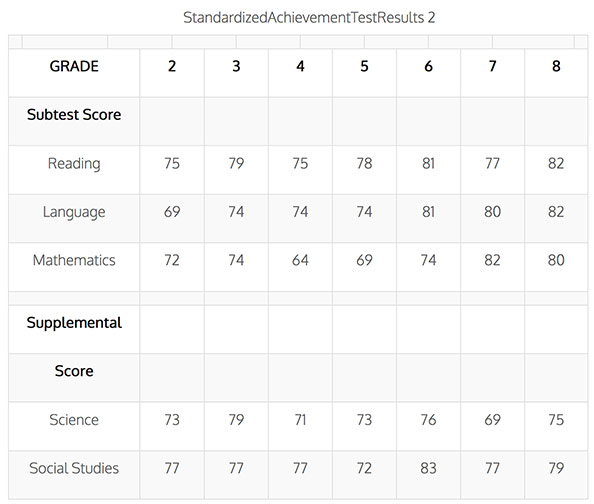
We are very proud to announce that our students continue to performance well above the national norm in the Terra Nova Standardized Achievement Test. This Test (published by the CTB – McGraw Hill) is administered in grades two through eight in the spring of each year as part of the Catholic Schools Office’s assessment of the overall curriculum in the diocesan schools. The following graph and table demonstrate the wonderful test results for our students in the spring of 2014.
 \\
\\
|
GRADE |
2 |
3 |
4 |
5 |
6 |
7 |
8 |
|||||||||
|
Subtest Score |
|
|
|
|
|
|
|
|||||||||
|
Reading |
75 |
79 |
75 |
78 |
81 |
77 |
82 |
|||||||||
|
Language |
69 |
74 |
74 |
74 |
81 |
80 |
82 |
|||||||||
|
Mathematics |
72 |
74 |
64 |
69 |
74 |
82 |
80 |
|||||||||
|
Supplemental |
||||||||||||||||
|
Score |
||||||||||||||||
|
Science |
73 |
79 |
71 |
73 |
76 |
69 |
75 |
|||||||||
|
Social Studies |
77 |
77 |
77 |
72 |
83 |
77 |
79 |
|||||||||
Faculty and Staff
Dr. Stuart Robertson
Principal
Dr. Robertson became principal of St. Patrick Catholic School in July of 2015. A lifelong resident of Pelham and member of St. Patrick Parish, he brings over 30 years of educational experience to his position. He was a classroom teacher for 23 years, as well as adjunct faculty at both Rivier University and Merrimack College. The last 3 years Dr. Robertson has been a Training and Content Specialist for the international software company QSR International. He has been he recipient of the Presidential Award for Excellence in Science and Mathematics Teaching and recognized as New Hampshire’s Elementary Mathematics Teacher of the Year. He received a B.A. in both Elementary Education and History and a M.Ed. in Curriculum and Instruction with a concentration in Educational Technology from the University of Lowell, a C.A.G.S in Leadership and Instruction from Rivier, and an Ed.D. in Leadership and Learning from the University of Massachusetts at Lowell.
Mrs. Carol Blazon
Administrative Assistant
Carol Blazon has been an administrative assistant to six different principals over the past 27 years at Saint Patrick Catholic School. A member of Saint Patrick Parish for 39 years, she has served as a eucharistic minister, CCD assistant to two directors, CYO cheerleading assistant coach, and “Team Mom.” Most importantly, she has been the Ambassador of Good Will for all who are involved at SPCS.
Mrs. Margaret Liotta
Pre-K
Mrs. Liotta is a third-year teacher here at SPCS. She received her bachelor’s degree from Salem State University and her master’s from Leslie University. Her core of studies concentration was in Curriculum and Instruction through the Arts.
Ms. Victoria Rapsis
Kindergarten
A first-year teacher at SPCS, Victoria Rapsis arrives with experience in the primary grades.
Mrs. Kellie McCann
Grade 1
A first-year teacher at SPCS, Mrs. McCann is no stranger to first grade. Before coming to St. Patrick Catholic School, Kellie taught first grade at St. Jean d’ Arc school in Lowell, MA. She earned her bachelor’s degree from Northeastern and holds a master’s from Rivier University. Prior to teaching, she worked in telecommunication sales and service for 18 years. Mrs. McCann lives in Chelmsford, MA with her husband, Jim, and her 2 children, Michael, and Cortney.
Mrs. Carolyn Jedraszek
Grade 2
Although this is Mrs. Jedraszek’s first year as our second grade teacher, she brings with her a strong background in education and many years of experience. She received her bachelor’s degree in education and special education from Fitchburg State College and her master’s degree from the University of Lowell. She has taught 6th grade in Ashby, MA, 3rd grade in Leominser, MA, special education in Lowell, MA, and served as the Director of Education and also as a principal in Lowell, MA. Before taking over our second grade classroom, she served a very valuable role as a long-term substitute teacher at SPCS for the past several years.
Mr. Brian Clark
Grade 3/5
Mr. Clark is a fifth-year teacher at SPCS, and has been a parishioner at St. Pat’s for 31 years. Mr. Clark holds a bachelor’s degree in Business and Education, and a master’s degree in Education from Cambridge College. He is certified to teach elementary education in the state of New Hampshire.
Mr. Charles Curfman
Grade 3/5
Charles Curfman has been at Saint Patrick Catholic School for fourteen years. His impressive resume includes a bachelor’s degree from Plymouth State College in Business Administratioin and Accounting, where he received the Myrtle L. Grover Endowed Scholarship, the Scott Descoteaux Memorial Scholarship, and the Outstanding Senior Accounting Major Award. He went on to Boston College, where he received his master’s degree in Business Administration and Finance. He earned a second master’s degree in Elementary and General Special Education from Rivier College. Mr. Curfman is certified in Elementary and General Special Education by New Hampshire.
Mrs. Lynne Stader
Grade 7, Literature & Writing 6-8
Lynne Stader has been teaching for 38 years, the last 27 years at SPCS. She attended Bowling Green State University, where she earned her bachelor’s degree in Education and Music. Her vast teaching experience includes teaching Kindergarten at St. Joseph School in Lowell, MA, teaching Music at St. John the Baptist in Michigan, and teaching Language Arts and Social Studies at a public middle school in Ohio. She was the recipient of the NH Society for Technology in Education’s Technology Educator Award in 2000, and is a multi-year honoree in Who’s Who Among America’s Teachers. Mrs. Stader was also recognized in 2012 as New Hampshire VFW Teacher of the Year, acknowledging her efforts in citizenship education, fostering patriotism, and student leadership.
Mrs. Mary Tryon
Grade 8, Language Arts & Social Studies 6-8, Religion 8
Mary Tryon is the senior member of the staff at SPCS, having served for 33 years. She earned her bachelor’s degree in History and Education from the University of Lowell. She was an integral part of the school’s recent successful accreditation preparation. She is certified to teach social studies by the state of New Hampshire.
Mrs. Lori McDermott
Information Technology Coordinator, Computers & Math 7-8
A teacher at SPCS since 2002, Lori McDermott earned her bachelor’s degree in Electrical Engineering from Lehigh University and a master’s degree in Computer/Systems Engineering from Rensselaer Polytechnic Institute. Mrs. McDermott has her teacher certification from the state of New Hampshire.
Mrs. Denise Montminy
French
Denise Montminy, a 23-year veteran at SPCS, earned her degree in Business from Rivier College. A combination of her family’s French Canadian background and courses that she has taken at Rivier College have provided this French teacher with extensive knowledge of the French language. Madame is currenlty pursuing a master’s in Educational Studies at Southern New Hampshire University. While at SPCS, she also has served as coordinator of the school’s ski program. She is certified to teach elementary education through the Diocese of Manchester.
Mr. Rick Morgan
Physical Education
Rick Morgan is a first-year teacher here at SPCS. He holds a bachelor’s degree from New England College with a major in physical education, and a minor in coaching. Rick has coached for the past twenty years, and has organized many youth athlete camps and clinics.
Mrs. Marianne Lipari
Art
A graduate of St. Mary’s College, Marianne Lipari was an art teacher in the Lincoln public schools, Hudson public schools, and Hollis public schools. Mrs. Lipari has completed graduate course work at both Lesley College and Rivier College. A teacher at SPCS since 1998, Mrs. Lipari is certified in both New Hampshire and Indiana in Art Education.
Mrs. Mary Quigley
Music
Mary Quigley is in her first year as the Music Teacher at St. Patrick Catholic School. She holds a Bachelor’s degree in Music and has been teaching in the classroom for 5 years. She also teaches private lessons on violin, viola, and cello at St. Patrick Catholic School. Mrs. Quigley’s primary instrument is the violin, and she has performed in various orchestras including the Nashua Chamber Orchestra and the Lowell Philharmonic. She enjoys playing with her dog, baking, and playing music with her husband Jordan, who plays the guitar.
Mr. Leon Grande
Band/Instrumental Instruction
Mr. Grande served as a music teacher and Supervisor of the Fine and Performing Arts in the Dracut Public School System. He was also the Director of the Marching Band, the Chorus, and is still the Director of the Dracut Town Choral Group. He brings thirty-five years of music education experience to St. Patrick Catholic School.
Mrs. Beverly Chiras
Librarian
Mrs. Chiras returns to SPCS as our Librarian after taking time off to help raise her grandchildren.
Mrs. Kimberly Michel
Instructional Aid, Religion 7
Kim Michel, a graduate of Saint Patrick Catholic School, is a fourth-year Instructional Aid supporting grades Pre-K, 1 & 2. Mrs. Michel is also a St. Patrick’s parent with 2 sons, Ryan, her oldest son, also an alumni of SPCS, and Cameron, a current student in grade 7. With her constant benevolent attitude, it’s no surprise that Kim has recently joined our After Care team as a co-care provider for the primary grades program.
Mrs. Kristen Cunha
Nurse
Nurse Kristen Cunha earned her Bachelor of Science degree in Nursing at the University of Massachusetts, Amherst. She has been a pediatric registered nurse for the past ten plus years. She has worked in the hospital setting as well as in the pediatrician’s office. She is currently a Certified Pediatric Nurse, bringing with her a wealth of knowledge on pediatric health. She is also a parent of two students at SPCS, Aleena in Kindergarten and Landon in Pre-K.
Blaire McCarthy
Guidance Counselor
Mrs. McCarthy comes to St. Pats with a wealth of experience in the areas of Psychology and Sociology. She holds a B.A. in Psychology and Sociology from Merrimack College, and earned her master’s in Counseling and Psychotherapy from Rivier College. In addition to being Guidance Counselor at St. Joseph Regional School in Salem, NH for the past 10 years, Blaire has also performed Per Diem work at the Mental Health Center of Greater Manchester. Being no stranger to parenting, Mrs. McCarthy is the mother of 3 boys. She holds her New Hampshire state certification in Guidance Counseling.
Directions
From the North:
Take I-93 heading south to Exit 3. Bear right off the exit. At the 2nd set of lights (farm stand in front of you), take a right onto Rte.111A West. Follow for approx. 4 miles. At the stop sign (Golden Brook School in front of you), take a left continuing on Rte. 111A West for approx. 3 miles. At the blinking light, take a left onto Main Street. The school is the 4th building on the right (The soccer field is behind the school building).
From the South:
Take I-93 North to Exit 2. Take a left off the exit. At the 3rd set of lights, take a left onto Stiles Road. Follow to the end (.8 miles); at the stop sign, take a right onto Route 38 (the Ice Center will be on your right).Follow for 4.4 miles. At the traffic light, turn right onto Main Street in Pelham. Our school is the 2nd building on the left (The soccer field is behind the school building).
From Rt. 3 North:
Take Route 3 heading south to Exit 2. Once on Exit 2, stay in the left lane and follow signs to Hudson – Rte. 3A. Once over the bridge/river, take a right. At the third set of lights, take a left onto Dracut Road. Follow for 1.9 miles. Take a left onto Sherburne Road (follow for 1.9 miles). Turn left at the stop sign. Approximately 100 feet down, take a right onto Route 111A East (Marsh Road). Follow for 2.5 miles. At the stop sign in the center of town, continue straight across the intersection. Take a right onto Main Street at the stop sign. We are the 4th building on the right.
From Route 3 South:
Take Route 3 heading North to Exit 2. Follow directions for “From Rt. 3 North”.
More Background On SaintPatrickSchool.net
SaintPatrickSchool.net was the online home of Saint Patrick Catholic School, a private Roman Catholic elementary and middle school that operated for more than half a century in Pelham, New Hampshire. Located at 16 Main Street in the center of Pelham, the school educated children from pre-kindergarten through eighth grade and was closely connected to Saint Patrick Parish and the Roman Catholic Diocese of Manchester.
Although Saint Patrick Catholic School closed in 2015, SaintPatrickSchool.net remains valuable as a historical record of the institution. Material preserved from the school's final years provides an unusually detailed look at its curriculum, admissions policies, faculty, athletics, religious mission, standardized-test performance and community traditions.
The website is therefore best understood today not as the website of an operating school but as an archive of a local Catholic educational institution that served generations of families in southern New Hampshire.
Origins as Saint Patrick Convent School
Saint Patrick Catholic School traced its beginnings to 1960, when it was founded by Saint Patrick Parish. Its original name was Saint Patrick Convent School.
The name reflected the important role of women religious in the school's early history. For many years, the school was staffed by Sisters of Mercy from nearby Windham, New Hampshire. Catholic religious orders such as the Sisters of Mercy played a major role in the development of parochial education throughout New England, allowing individual parishes to establish schools combining conventional academic instruction with Catholic religious formation.
Saint Patrick followed that traditional model.
Over time, however, its faculty changed. Lay educators increasingly replaced members of the religious order. By the early 1990s, the institution had formally changed its name from Saint Patrick Convent School to Saint Patrick School. By its final years, its faculty consisted entirely of lay personnel rather than religious sisters.
Despite that change, Catholic identity remained central to the school's purpose.
Ownership, Parish Connection and Diocese
Saint Patrick School was founded by and closely associated with Saint Patrick Parish in Pelham. Ecclesiastically, it operated within the Catholic Diocese of Manchester, which encompasses Catholic institutions throughout New Hampshire.
The relationship between the parish and school was more than nominal. Religious instruction formed part of the curriculum, parish affiliation was incorporated into aspects of admissions and tuition policy, and school documents repeatedly described parents, teachers, the parish and the school as partners in children's spiritual as well as academic development.
The physical relationship was also close. The school stood on the Saint Patrick church campus at 16 Main Street. Contemporary descriptions placed it beside other parish facilities.
That connection did not disappear when the school closed. Saint Patrick Parish's current history states that after the school closed in the summer of 2015, parish offices were moved into the ground floor of the former school building in 2016. The parish currently lists its office at 16 Main Street, the former school address.
Thus, although the educational institution disappeared, the property continued to play a role in Catholic life in Pelham.
Location and the Community It Served
Pelham lies in Hillsborough County in southern New Hampshire, close to the Massachusetts border. Its location made Saint Patrick School accessible not only to Pelham families but potentially to families from surrounding southern New Hampshire and northern Massachusetts communities.
The school was situated in the center of Pelham rather than on an isolated suburban campus. Directions published for families provided approaches from Interstate 93, Route 3, Route 38 and Route 111A.
The location reinforced Saint Patrick's identity as a parish and community school. It was not designed as a large regional preparatory academy. Its character was that of a comparatively small pre-K-through-eight Catholic school in which parish life, education, athletics, parents and community events frequently overlapped.
That local identity is important in understanding both the school's appeal and its eventual vulnerability. Small religious schools can provide close-knit communities and individualized environments, but their financial viability can be particularly sensitive to changes in enrollment.
Enrollment and Popularity
Historical statistics provide some perspective on Saint Patrick School's size.
For the 2005-2006 school year, published National Center for Education Statistics data cited for the school showed an enrollment of 236 students, with 12.8 full-time-equivalent teachers and a student-teacher ratio of approximately 18.4 to one.
By 2015, the situation had changed substantially.
A Pelham school warrant from that year proposed $34,000 for Child Benefit Services for 55 Pelham children in kindergarten through eighth grade attending Saint Patrick Catholic School. That figure should not be interpreted as the school's complete enrollment because it specifically concerned Pelham children covered by the warrant. Nevertheless, it provides useful contemporary evidence about the local student population associated with Saint Patrick shortly before its closure.
Ultimately, insufficient enrollment for the coming school year was cited as the reason the school closed in August 2015.
The contrast between the earlier enrollment figure of 236 and the enrollment difficulties of 2015 illustrates one of the most important developments in the school's history.
Educational Mission
Saint Patrick's stated educational philosophy combined academic development with Catholic formation.
The school described itself as a family providing students with a nurturing academic environment intended to encourage respect and responsibility while grounding children in Catholic values and beliefs.
Parents were considered essential participants rather than simply consumers of educational services. School policies characterized parents as children's primary educators and emphasized cooperation between home and school.
Families were expected to support educational and religious goals, participate in conferences and school activities, cooperate with disciplinary policies, monitor attendance and assignments, meet financial responsibilities and participate in fundraising.
This model reveals much about Saint Patrick's culture. Education was presented as a shared undertaking among students, teachers, parents and the Church.
Curriculum
Saint Patrick offered a broad elementary and middle-school curriculum.
Core subjects included English, mathematics, science and social studies. Religion was integrated into the academic program, while students also had access to library instruction, computer technology, physical education, art and music.
French was offered in grades five through eight.
The curriculum followed requirements established by the Diocese of Manchester, while teachers in the school's final period were state-certified lay educators.
This combination of conventional academic subjects, religion, languages, technology, fine arts and physical education indicates that Saint Patrick attempted to provide a complete elementary and middle-school experience rather than limiting itself to basic academics and religious instruction.
Accreditation
One of Saint Patrick School's notable institutional credentials was accreditation by the New England Association of Schools and Colleges, commonly known as NEASC.
Accreditation was significant for a small private school because it involved external review of educational practices and institutional standards. The school's own materials prominently identified its accredited status.
The accreditation also helps distinguish Saint Patrick from informal or narrowly religious educational programs. It operated as an established academic institution while maintaining an explicitly Catholic mission.
Standardized Test Performance
Saint Patrick also used standardized testing to evaluate academic performance.
Students in grades two through eight took the TerraNova standardized achievement test as part of the Diocese of Manchester Catholic Schools Office's assessment program.
Results published for spring 2014 showed percentile-type scores that were generally well above the national midpoint across numerous grades and subjects.
Reading results ranged from 75 in second and fourth grades to 82 in eighth grade. Language scores ranged from 69 in second grade to 82 in eighth grade. Mathematics results included scores of 72 in second grade, 74 in third, 64 in fourth, 69 in fifth, 74 in sixth, 82 in seventh and 80 in eighth.
Science and social-studies results were similarly strong in many grades.
The school was careful, however, to present standardized testing as only one measurement of educational success. Its philosophy emphasized problem solving, conceptual understanding, discussion, evaluation of ideas, religion, art and the development of responsible Christian citizens.
That broader definition of achievement was consistent with Saint Patrick's overall mission.
Faculty and Leadership
SaintPatrickSchool.net devoted considerable space to teachers and staff, another indication of the importance the school placed on its community identity.
Among its longest-serving educators were teachers who had spent decades at Saint Patrick.
Lynne Stader, for example, had taught for 38 years, including 27 at Saint Patrick. Her background included education and music, and she had received the New Hampshire Society for Technology in Education's Technology Educator Award as well as recognition as New Hampshire VFW Teacher of the Year.
Mary Tryon had served at Saint Patrick for 33 years and taught eighth grade as well as language arts, social studies and religion.
Other faculty backgrounds were unusually diverse for a relatively small school. Lori McDermott, who worked in information technology and mathematics, held degrees in electrical engineering and computer/systems engineering. Charles Curfman had graduate training in business administration, finance, elementary education and special education.
The school also employed specialists in French, physical education, art, music, instrumental instruction and library services, along with a nurse and guidance counselor.
Dr. Stuart Robertson became principal in July 2015. His appointment came immediately before the school's closure. Robertson was a longtime Pelham resident and Saint Patrick parishioner with decades of educational experience. His honors included the Presidential Award for Excellence in Mathematics and Science Teaching and recognition as New Hampshire's Elementary Mathematics Teacher of the Year.
His extremely short tenure illustrates how abruptly the school's final chapter unfolded.
Admissions and School Community
Saint Patrick admitted students without discrimination on the basis of gender, race, color or national or ethnic origin.
When demand exceeded available places, however, its admissions system reflected the school's community structure. Priority categories included returning students, children of faculty, siblings of existing students, children of alumni, children of registered Saint Patrick parishioners and children who had attended the school's kindergarten or pre-K programs.
Students applying to grades one through eight were expected to provide report cards and standardized-test results. Interviews were part of the process, and testing could be required for applicants to grades three through eight.
Non-Catholic students could also attend if their families accepted the philosophy of the school and space was available.
This is another important detail about Saint Patrick: although unmistakably Catholic, it was not restricted exclusively to Catholic children.
Tuition, Fees and Family Responsibilities
Like most private Catholic schools, Saint Patrick depended on tuition and family financial participation.
During the 2014-2015 period, the school used the SMART Tuition Management Program, allowing tuition to be divided into 12 monthly payments. Families could also pay directly.
Registration fees were nonrefundable, and the school maintained policies concerning late balances, withdrawals and release of records.
Additional costs included athletics and certain field trips. Before-school and after-school care were available for additional charges.
The school's financial policies also reflected the parish connection. Qualification as a registered parish member involved registration with a New Hampshire Catholic parish, participation in parish life, an annual meeting with the pastor during registration and financial support of the parish.
Fundraising was another expected component of family participation.
Athletics and the Tri-County League
Sports were a visible part of Saint Patrick's identity, particularly for students in grades five through eight.
The school competed in the Tri-County League's small-school division. Its interscholastic offerings included boys' and girls' soccer in the fall, track and girls' softball in the spring. Basketball was available through the Saint Patrick Parish CYO program, while other recreational opportunities over the years included activities such as skiing and snowboarding.
One of the school's most celebrated athletic accomplishments came in 2013.
The boys' soccer team completed its regular season with a 7-1-2 record, advanced through the playoffs and finished as runner-up in the Division 4 Tri-County Soccer League. It was identified by the school as its first boys' soccer Tri-County League runner-up trophy.
The girls' soccer team subsequently reached the league playoffs, track athletes earned medals and the softball program also competed successfully.
These activities mattered beyond wins and losses. Coaches were volunteers, and athletics depended heavily on family and community participation.
Traditions and Student Life
Some of Saint Patrick's most distinctive features were traditions that would have been immediately recognizable to former students but difficult to reconstruct without surviving records.
Among them was the Harvest Feast, involving younger grades in an elaborate historical-themed activity near Beaver Brook. Sixth graders participated in a Nature's Classroom trip, while eighth graders traditionally traveled to Washington, D.C.
The school also offered a student leadership and campus-ministry program known as T.I.C. T.A.C., standing for “Together In Christ Taking A Challenge.”
These activities illustrate how Saint Patrick attempted to combine academics with experiential education, leadership, religion and community traditions.
For alumni, such events were likely at least as memorable as conventional classroom instruction.
Honoring Veterans and Community Service
One of the clearest examples of Saint Patrick's community role occurred shortly before the school closed.
In May 2015, seventh-grade students held the school's 17th annual spring patriotic assembly, that year focusing on Memorial Day and honoring military veterans.
Contemporary local coverage reported that nearly 100 guests attended in addition to the student body. Participants included members of Pelham's John H. Hargreaves VFW Post 10722 and veterans from the New Hampshire Veterans Home in Tilton.
Students helped conduct the ceremony, and representatives of the military branches participated in the processional.
The event reflected an emphasis on leadership, citizenship and volunteerism that appeared repeatedly in descriptions of the school. It is particularly poignant in retrospect because it occurred only a few months before Saint Patrick ceased operating.
Awards and Recognition
Saint Patrick's historical record contains several forms of recognition rather than one dominant institutional award.
The school held NEASC accreditation, students posted strong TerraNova results, athletic teams achieved league recognition, and individual teachers received professional honors.
Faculty recognition included awards for mathematics and science teaching, educational technology, citizenship education and student leadership.
The school's 2013 boys' soccer runner-up trophy also held special significance because school accounts described it as the first such Tri-County League achievement for the boys' program.
Taken together, these accomplishments suggest that Saint Patrick measured success across academics, athletics, faith, citizenship and faculty achievement.
Press and Media Coverage
Saint Patrick was principally a local institution, so its media footprint was correspondingly local rather than national.
Community news coverage documented events such as the 2015 veterans celebration. Historical references to the school's closure also became part of published records about Saint Patrick Parish and Pelham.
The closing itself was significant enough to become part of the parish's official history.
This local scale is important when evaluating the school's historical popularity or influence. Saint Patrick was not notable because it attracted national media attention. Its significance came from sustained participation in one community for approximately 55 years.
Closure in August 2015
Saint Patrick Catholic School closed in August 2015 because of insufficient enrollment for the approaching academic year.
The timing made the closure particularly consequential. A new principal had been appointed in July, suggesting that preparations for continued operation had been underway shortly beforehand.
The shutdown ended an educational history stretching from 1960 to 2015.
The parish subsequently adapted the building to other purposes. In 2016, parish offices moved into the ground floor of the former school, and Saint Patrick Parish continues to operate at the Main Street campus.
The school itself, however, did not reopen.
Cultural and Social Significance
The significance of Saint Patrick School is easiest to understand at the community level.
For roughly 55 years, it provided Pelham-area families with an alternative to public education built around Catholic religious teaching. Multiple generations passed through its classrooms. Alumni later became parents, parish members and, in some cases, members of the school's own staff.
Its history also mirrors a larger transformation in American Catholic education.
Saint Patrick began with a faculty substantially staffed by a religious order. Over succeeding decades, sisters were gradually replaced by professionally trained lay educators. The school retained its Catholic identity while its staffing and administration evolved.
Eventually, another widespread challenge facing small parish schools—maintaining sufficient enrollment—became decisive.
For Pelham families who attended Saint Patrick, however, the institution was much more than an enrollment statistic. It was a network of teachers, classmates, parishioners, parents, coaches and traditions extending across decades.
The SaintPatrickSchool.net Website
During the school's operating years, SaintPatrickSchool.net functioned as a practical information resource for existing and prospective families.
Its content covered the major questions a parent considering Saint Patrick would have wanted answered: what the school believed, who taught there, what subjects students studied, how admissions worked, what tuition arrangements were available, what extracurricular activities existed and how to reach the campus.
Major sections included information about the school, admissions, tuition, curriculum, standardized testing, athletics, faculty and staff, and driving directions.
The website also preserved accomplishments that otherwise could easily disappear from the public record: individual faculty biographies, test results, athletic achievements and descriptions of school traditions.
That archival function has become more important with time.
SaintPatrickSchool.net Today
Visitors discovering SaintPatrickSchool.net today should understand immediately that they are looking at the history of a closed institution rather than a currently enrolling Catholic school.
The school ceased operation in August 2015.
The surviving content nevertheless provides a detailed snapshot of Saint Patrick during its final period. It documents a small Catholic school with a broad curriculum, experienced faculty, competitive athletics, standardized-test performance above national norms, religious formation, parent involvement and strong ties to the surrounding parish and community.
Saint Patrick Parish itself remains active in Pelham, and the former school building continues to be associated with parish operations.
In this sense, the physical and institutional legacy of Saint Patrick School has not entirely disappeared.
Why the Website Still Matters
Archived school websites can become important pieces of local history because institutions often leave surprisingly little documentation after they close.
SaintPatrickSchool.net preserves details that would otherwise be scattered among newspaper archives, municipal records, parish documents, yearbooks and the memories of former students.
It records not merely that Saint Patrick School existed from 1960 until 2015, but what everyday life there looked like: French classes for older students, soccer matches in the Tri-County League, TerraNova testing, music and art instruction, before- and after-school programs, parent participation, parish connections, field trips, student leadership programs and teachers who sometimes remained at the school for decades.
Those specifics give the site continuing value.
Saint Patrick Catholic School's history is ultimately the story of a relatively small community institution with a long local reach. Founded by Saint Patrick Parish as a convent school staffed by Sisters of Mercy, it evolved into an accredited pre-K-through-eight school staffed by state-certified lay educators. It educated hundreds of children over its lifetime, maintained a strong Catholic identity and developed traditions remembered by students, parents and faculty.
Its closure in 2015 ended the school but not its historical significance.
SaintPatrickSchool.net now serves a very different purpose from the one for which it was created. Instead of recruiting new families or communicating with current parents, it preserves a record of more than five decades of Catholic education in Pelham, New Hampshire.